
Hunyuan-A13B-Instruct-LoRA 及 SwanLab 可视化记录
环境配置
# 换清华镜像源
!pip config set global.index-url https://pypi.tuna.tsinghua.edu.cn/simple

!pip install modelscope==1.25.0
!pip install transformers==4.51.3
!pip install accelerate==1.6.0
!pip install datasets==3.5.1
!pip install peft==0.15.2
!pip install swanlab==0.5.7
!pip install tiktoken考虑到部分同学配置环境可能会遇到一些问题,我们在 AutoDL 平台准备了 Hunyuan-A13B-Instruct 的环境镜像,点击下方链接并直接创建 Autodl 示例即可。 https://www.codewithgpu.com/i/datawhalechina/self-llm/Hunyuan-A13B-Instruct-lora
模型下载
# model_download.py
# 注意修改cache_dir为保存的路径
from modelscope import snapshot_download
model_dir = snapshot_download('Tencent-Hunyuan/Hunyuan-A13B-Instruct', cache_dir='/root/autodl-tmp', revision='master') ###可以根据自己需要修改下载模型所在的存储路径:cache_dir


print(f"模型下载完成,保存路径为:{model_dir}")注意事项!!!
在模型下载完成后,需要修改模型文件夹下的hunyuan.py文件,在开头加入以下代码:
import logging
logger = logging.getLogger(__name__)数据集构建
对大语言模型进行 supervised-finetuning(sft,有监督微调)的数据格式如下:
{
  "instruction": "回答以下用户问题,仅输出答案。",
  "input": "1+1等于几?",
  "output": "2"
}其中,instruction 是用户指令,告知模型其需要完成的任务;input 是用户输入,是完成用户指令所必须的输入内容;output 是模型应该给出的输出。
有监督微调的目标是让模型具备理解并遵循用户指令的能力。因此,在构建数据集时,我们应针对我们的目标任务,针对性构建数据。比如,如果我们的目标是通过大量人物的对话数据微调得到一个能够 role-play 甄嬛对话风格的模型,因此在该场景下的数据示例如下:
{
  "instruction": "你父亲是谁?",
  "input": "",
  "output": "家父是大理寺少卿甄远道。"
}所有的示例微调数据集位于 /dataset
数据准备
LoRA(Low-Rank Adaptation)训练的数据是需要经过格式化、编码之后再输入给模型进行训练的,我们需要先将输入文本编码为 input_ids,将输出文本编码为 labels,编码之后的结果是向量。我们首先定义一个预处理函数,这个函数用于对每一个样本,同时编码其输入、输出文本并返回一个编码后的字典:
def process_func(example):
    MAX_LENGTH = 1024 # 设置最大序列长度为1024个token
    input_ids, attention_mask, labels = [], [], [] # 初始化返回值
    # 适配chat_template
    instruction = tokenizer(
        f"<s><|im_start|>system\n现在你要扮演皇帝身边的女人--甄嬛<|im_end|>\n"
        f"<|im_start|>user\n{example['instruction'] + example['input']}<|im_end|>\n"
        f"<|im_start|>assistant\n<think>\n\n</think>\n\n",
        add_special_tokens=False
    )
    response = tokenizer(f"{example['output']}", add_special_tokens=False)
    # 将instructio部分和response部分的input_ids拼接,并在末尾添加eos token作为标记结束的token
    input_ids = instruction["input_ids"] + response["input_ids"] + [tokenizer.pad_token_id]
    # 注意力掩码,表示模型需要关注的位置
    attention_mask = instruction["attention_mask"] + response["attention_mask"] + [1]
    # 对于instruction,使用-100表示这些位置不计算loss(即模型不需要预测这部分)
    labels = [-100] * len(instruction["input_ids"]) + response["input_ids"] + [tokenizer.pad_token_id]
    if len(input_ids) > MAX_LENGTH:  # 超出最大序列长度截断
        input_ids = input_ids[:MAX_LENGTH]
        attention_mask = attention_mask[:MAX_LENGTH]
        labels = labels[:MAX_LENGTH]
    return {
        "input_ids": input_ids,
        "attention_mask": attention_mask,
        "labels": labels
}Hunyuan-A13B-Instruct 采用的 Chat Template格式如下:
messages = [
    {"role": "system", "content": "===system_message_test==="},
    {"role": "user", "content": "===user_message_test==="},
    {"role": "assistant", "content": "===assistant_message_test==="},
]由于 Hunyuan-A13B-Instruct 是混合推理模型,因此可以手动选择开启思考模式
不开启 thinking mode
messages = [
    {"role": "system", "content": "===system_message_test==="},
    {"role": "user", "content": "===user_message_test==="},
    {"role": "assistant", "content": "===assistant_message_test==="},
]

text = tokenizer.apply_chat_template(
    messages,
    tokenize=False,
    add_generation_prompt=True,
    enable_thinking=False
)
print(text)<|im_start|>system
===system_message_test===<|im_end|>
<|im_start|>user
===user_message_test===<|im_end|>
<|im_start|>assistant
<think>
</think>
===assistant_message_test===<|im_end|>
<|im_start|>assistant
<think>
</think>开启 thinking mode
messages = [
    {"role": "system", "content": "===system_message_test==="},
    {"role": "user", "content": "===user_message_test==="},
    {"role": "assistant", "content": "===assistant_message_test==="},
]

text = tokenizer.apply_chat_template(
    messages,
    tokenize=False,
    add_generation_prompt=True,
    enable_thinking=True
)
print(text)<|im_start|>system
===system_message_test===<|im_end|>
<|im_start|>user
===user_message_test===<|im_end|>
<|im_start|>assistant
<think>
</think>
===assistant_message_test===<|im_end|>
<|im_start|>assistant加载模型和 tokenizer
mode_path = '/root/autodl-tmp/Tencent-Hunyuan/Hunyuan-A13B-Instruct'
# 加载tokenizer
tokenizer = AutoTokenizer.from_pretrained(mode_path, trust_remote_code=True)

# 加载模型
model = AutoModelForCausalLM.from_pretrained(mode_path, device_map="auto",torch_dtype=torch.bfloat16, trust_remote_code=True)Lora Config
LoraConfig这个类中可以设置很多参数,比较重要的如下
task_type:模型类型,现在绝大部分decoder_only的模型都是因果语言模型CAUSAL_LMtarget_modules:需要训练的模型层的名字,主要就是attention部分的层,不同的模型对应的层的名字不同r:LoRA的秩,决定了低秩矩阵的维度,较小的r意味着更少的参数lora_alpha:缩放参数,与r一起决定了LoRA更新的强度。实际缩放比例为lora_alpha/r,在当前示例中是32 / 8 = 4倍lora_dropout:应用于LoRA层的dropout rate,用于防止过拟合
config = LoraConfig(
    task_type=TaskType.CAUSAL_LM,
    target_modules=["q_proj", "k_proj", "v_proj", "o_proj", "gate_proj", "up_proj", "down_proj"],
    inference_mode=False, # 训练模式
    r=8, # Lora 秩
    lora_alpha=32, # Lora alpha
    lora_dropout=0.1 # Dropout 比例
)Training Arguments
output_dir:模型的输出路径per_device_train_batch_size:每张卡上的batch_sizegradient_accumulation_steps: 梯度累计num_train_epochs:顾名思义epoch
args = TrainingArguments(
    output_dir="./output/Hunyuan-A13B-Instruct", # 注意修改
    per_device_train_batch_size=4,
    gradient_accumulation_steps=4,
    logging_steps=10,
    num_train_epochs=1,
    save_steps=100,
    learning_rate=1e-4,
    save_on_each_node=True,
    gradient_checkpointing=True,
    report_to="none",
)SwanLab 简介
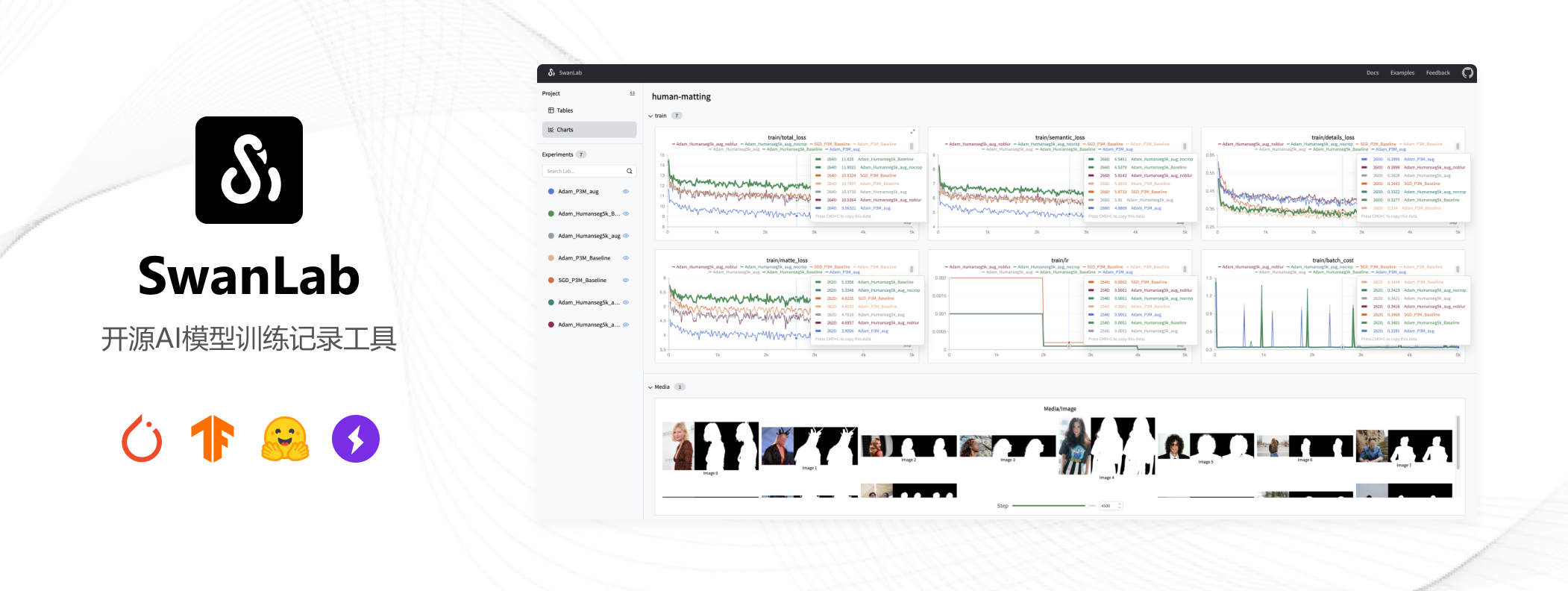
SwanLab 是一个开源的模型训练记录工具,面向 AI 研究者,提供了训练可视化、自动日志记录、超参数记录、实验对比、多人协同等功能。在 SwanLab 上,研究者能基于直观的可视化图表发现训练问题,对比多个实验找到研究灵感,并通过在线链接的分享与基于组织的多人协同训练,打破团队沟通的壁垒。
为什么要记录训练
相较于软件开发,模型训练更像一个实验科学。一个品质优秀的模型背后,往往是成千上万次实验。研究者需要不断尝试、记录、对比,积累经验,才能找到最佳的模型结构、超参数与数据配比。在这之中,如何高效进行记录与对比,对于研究效率的提升至关重要。
实例化 SwanLabCallback
建议先在 SwanLab 官网 注册账号,然后在训练初始化阶段选择
(2) Use an existing SwanLab account 并使用 private API Key 登录
import swanlab
from swanlab.integration.transformers import SwanLabCallback

# 实例化SwanLabCallback
swanlab_callback = SwanLabCallback(
    project="Hunyuan-A13B-Instruct-Lora",  # 注意修改
    experiment_name="Hunyuan-A13B-Instruct-LoRA-experiment"  # 注意修改
)使用 Trainer 训练
trainer = Trainer(
    model=model,
    args=args,
    train_dataset=tokenized_id,
    data_collator=DataCollatorForSeq2Seq(tokenizer=tokenizer, padding=True),
    callbacks=[swanlab_callback] # 传入之前的swanlab_callback
)
trainer.train()TrainOutput(global_step=233, training_loss=3.3132195984345136, metrics={'train_runtime': 4321.001, 'train_samples_per_second': 0.863, 'train_steps_per_second': 0.054, 'total_flos': 2.225441122839429e+17, 'train_loss': 3.3132195984345136, 'epoch': 0.9989281886387996})训练完成后,打开 SwanLab ,可以查看训练过程中记录的参数和可视化的训练 loss 曲线:
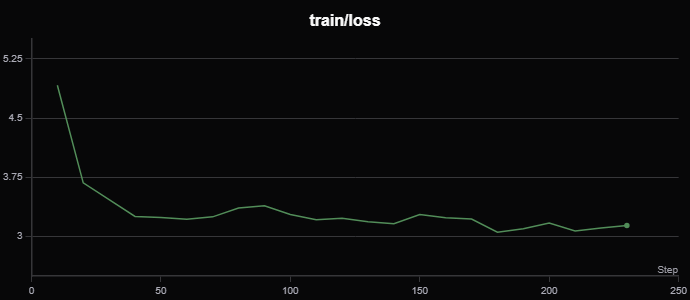
示例的训练记录公开链接如下,供参考
图表 | Hunyuan-A13B-Instruct-Lora/Hunyuan-A13B-Instruct-LoRA-experiment
加载 lora 权重推理
得到任意 checkpoints 之后加载 lora 权重进行推理:
from transformers import AutoModelForCausalLM, AutoTokenizer
import torch
from peft import PeftModel

mode_path = '/root/autodl-tmp/Tencent-Hunyuan/Hunyuan-A13B-Instruct' #这里修改实际的模型路径
lora_path = '/root/output/Hunyuan-A13B-Instruct/checkpoint-233' # 这里改称你的 lora 输出对应 checkpoint 地址

# 加载tokenizer
tokenizer = AutoTokenizer.from_pretrained(mode_path, trust_remote_code=True)

# 加载模型
model = AutoModelForCausalLM.from_pretrained(mode_path, device_map="auto",torch_dtype=torch.bfloat16, trust_remote_code=True)

# 加载lora权重
model = PeftModel.from_pretrained(model, model_id=lora_path)
import re
messages = [
    {"role": "user", "content": "who are you?"},
]
tokenized_chat = tokenizer.apply_chat_template(messages, tokenize=True, return_tensors="pt",
                                                enable_thinking=False # Toggle thinking mode (default: True)
                                                )

outputs = model.generate(tokenized_chat.to(model.device), max_new_tokens=4096)


output_text = tokenizer.decode(outputs[0])

answer_pattern = r'<answer>(.*?)</answer>'
answer_matches = re.findall(answer_pattern, output_text, re.DOTALL)

answer_content = [match.strip() for match in answer_matches][0]
print(f"answer_content:{answer_content}\n\n")answer_content:I'm HunYuan, Tencent's AI assistant. I'm here to help you with any questions or tasks you have. How can I assist you today?